
Watermouth Castle is a building in Watermouth, near Ilfracombe, North Devon, England, designed by George Wightwick as a residence for the Bassett family in the mid-19th century and is not a true castle but a country house built to resemble one. It has been designated as a Grade II* listed building.

The Lynton and Barnstaple Railway (L&B) was a single track, narrow gauge railway. It opened in May 1898 and ran for slightly more than 19 mi through the area bordering Exmoor in North Devon, England. Although it opened after the Light Railways Act 1896 came into force, it was authorised and constructed before that act. It was authorised under its own Act of Parliament and built to higher (and more costly) standards than similar railways of the time. It was notable as the only narrow gauge railway in Britain that was required to use main-line standard signalling. For a short period, it earned a modest return for shareholders, but for most of its existence it made a loss. In 1923, the L&B was taken over by the Southern Railway, and eventually closed in September 1935.
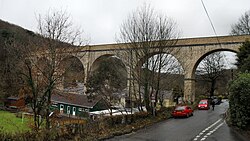
Chelfham Viaduct is a railway viaduct built in 1896–97 to carry the single track, narrow-gauge Lynton and Barnstaple Railway (L&B) across the Stoke Rivers valley. Designed by L&B engineer, FW Chanter, and containing over a quarter of a million Marland bricks, its eight arches - each 42 ft wide and 70 ft high - meaning that the 132 yd-long viaduct is the largest narrow gauge railway structure in England. Chelfham Viaduct was Bridge number 22 of the 80 that carried or spanned the railway over its 19 mi length. The viaduct was classified as a Grade II listed structure on 25 February 1965.
